

Converting Piston Drop to Crank Rotation

Many workshop manuals specify engine timing as piston drop measured down the bore before top dead centre (BTDC), while others use degrees of crankshaft rotation measured with a degree disc. Few manuals provide figures in both formats, which can make it difficult to use the timing method you prefer.
If your manual specifies piston drop before TDC, but you would rather set the timing using degrees of crankshaft rotation with a degree disc, this guide shows how to convert piston position into crankshaft rotation. The calculation uses the engine stroke and connecting rod length to determine the crank angle that corresponds to a given piston drop. If you would rather avoid the maths, you can skip to the bottom of the page and download our spreadsheet, which performs the calculation automatically.
Measuring piston position down the bore is sometimes less precise than timing directly with a degree disc on the crankshaft, but many workshop manuals only provide piston-drop figures. Converting piston drop into degrees before TDC allows very accurate timing to be set when assembling an engine with a degree disc fitted to the crankshaft.
Required Information for Calculation

The method shown on this page uses trigonometry to do the conversion and all you need to know before starting is:
The length of your conrod (between centres of the big end and small end)
Stroke of the engine
Notation and Symbols
a = third side of the imaginary triangle made up with the conrod (c) and line between the big end and main shafts (b) in mm
b = half stroke in mm (Stroke/2)
c = conrod length in mm
C = angle of engine rotation from top dead centre in degrees
d = piston drop in mm
S = engine stroke in mm
Draw the imaginary triangle
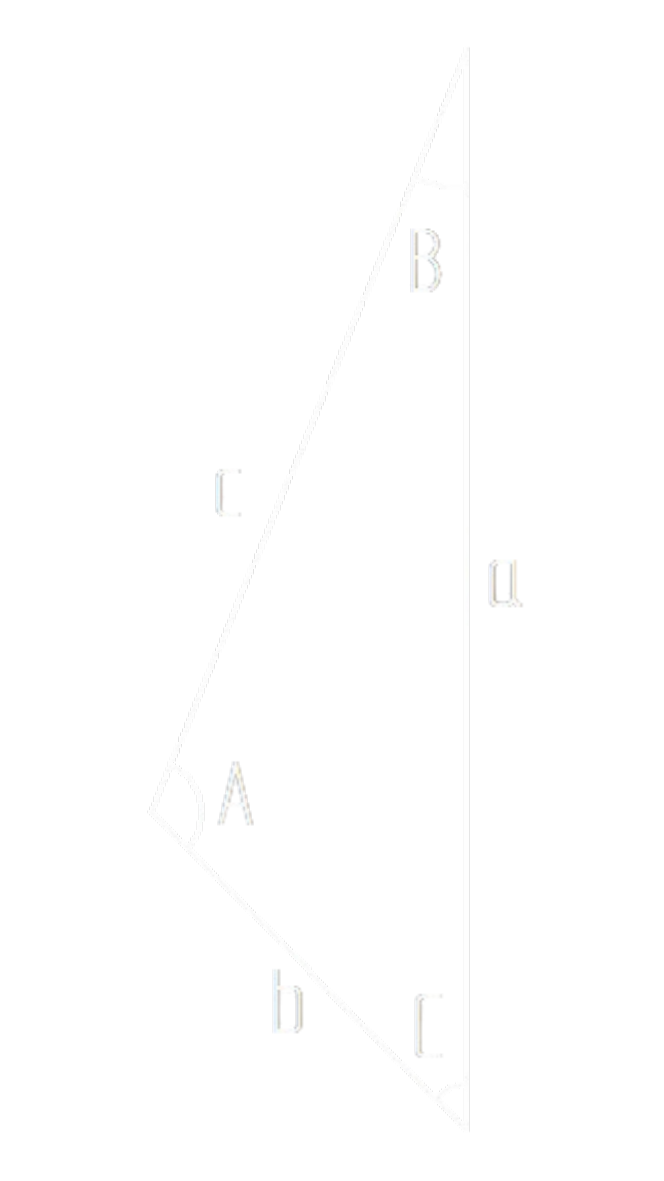
It always helps to start by drawing an imaginary triangle made up by the half stroke (b), conrod (c) and a vertical line from the main shaft to the small end (a).
Calculate the length of the third side (a)

When the piston is at TDC the half stroke and conrod make a straight line and the piston drop is 0. With this in mind it is simple to calculate the length of the third side by adding the half stroke and the conrod lengths and subtracting the piston drop.

Calculate angle C using the cosine rule

Now that you have the lengths of all three sides the Cosine rule, shown here, can be used to calculate the angle before or after TDC (C).
Feeling baffled?
If you have read all of the above and are left feeling confused, or would rather be out on your bike than sitting indoors with a pen and paper, we’ve created a spreadsheet do all the hard work. Simply input the information from your bike and get the answers calculated for you.
Return to Technical
Comments