

Calculating Cylinder Displacement and Compression Ratio

Learn how to calculate cylinder displacement and compression ratio for classic and vintage motorcycle engines. This guide explains the practical method to use your engine’s bore, stroke and combustion chamber volume to determine swept volume and static compression ratio, and outlines how to measure combustion chamber volume accurately.
Most standard production machines will have these figures clearly stated in the owner's manual. However, if you are fitting non standard parts and tuning an engine you may need to work these figures out for yourself.
If this all looks like a lot of hard work, why not skip to the bottom and download a spreadsheet we've created to do it all for you.
Required Information for Calculation
All you need to know before getting started is:
Engine bore in cm
Engine stroke in cm
Volume of combustion chamber in cc
Other units such as mm can be used but a correction factor at the end will be required. When using mm for bore and stroke answer will be given in cubic millimetres. This can be divided by 1000 to get capacity in cubic centimetres (cc).

Notation and Symbols
A = cross sectional area of the cylinder bore in cm²
CR = compression ratio
CV = combustion chamber volume in cc
D = displacement in cc
r = radius (half the bore, not forgetting any oversizes) in cm
S = engine stroke in cm
Measure the Combustion Chamber Volume
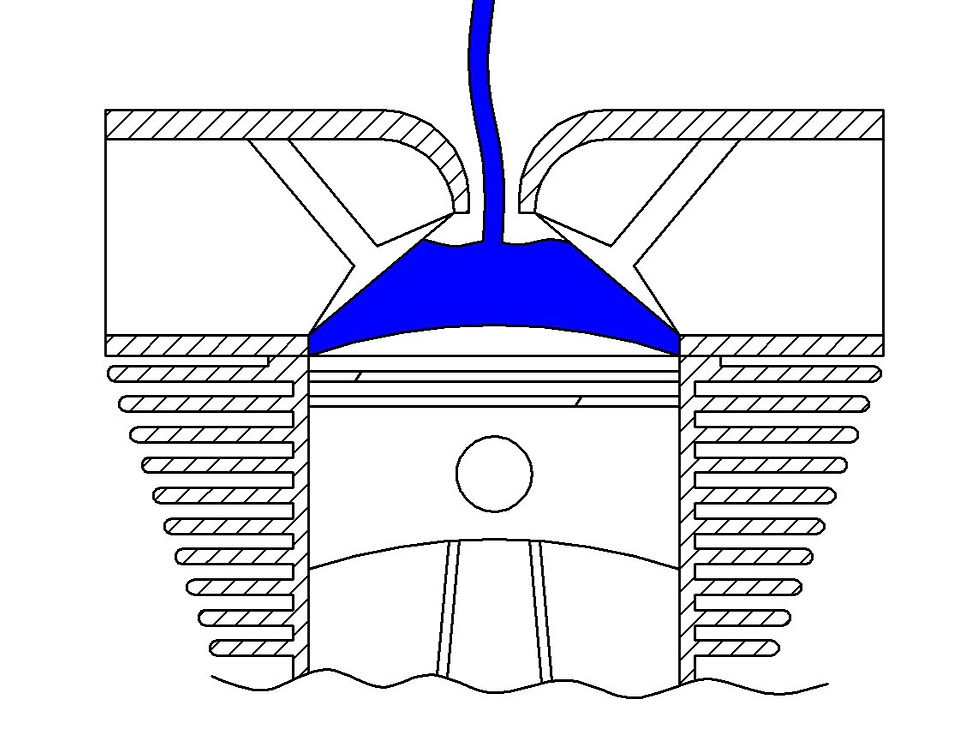
The easiest way to do this is by setting the engine with the piston at TDC and filling the combustion chamber, through the spark plug hole, with thin oil or similar until the top of the fluid is just level with the bottom thread of the plug hole. Use a burette or syringe to fill the chamber and make a note of the amount of fluid used.
On most engines it is necessary to lean the engine over so that the plug hole is vertical to ensure the combustion chamber is completely full with no air pockets.
Calculating Engine Displacement

The displacement of a cylinder is found by multiplying the cross sectional area of the cylinder by the height or, in this case, the stroke.
The cross sectional area and, in turn, the displacement is found using the equation shown here. Don't forget to include any over size if the engine has been re-bored. In the case of a multi cylinder engine simply multiply this answer by the number of cylinders.
Calculating Compression Ratio

Using the engine displacement and the combustion chamber volume the compression ratio can be easily calculated. Simply add the displacement to the combustion chamber volume and then divide the answer by the combustion chamber volume.
Spreadsheet Tool for Automation
If you have read all of the above and are left feeling confused, or would rather be out on your bike than sitting indoors with a pen and paper, we’ve created a spreadsheet do all the hard work. Simply input the information from your bike and get the answers calculated for you.
Return to Technical
Comments