

Norton ES2 - Touring Modifications

Over the last 10 years and 15,000 miles, I have developed my 1951 Norton ES2 into my idea of a practical classic touring bike, while trying to retain its traditional look and feel. From luggage and gearing to navigation, electrics and tyres, this page covers the modifications I've made to make the ES2 easier and more enjoyable to use on longer trips.
Panniers
Let's start with the big one, and the modification I am probably asked about most often - the panniers. I bought these with a rack to suit a modern Triumph, I then modified the rack to fit the ES2 frame whilst retaining the clips and fittings.
I did a lot of research before settling on the SW-Motech panniers, and I have never regretted my choice. As well as offering something like 35 litres of storage in each, they are genuinely waterproof and they can be locked closed and locked to the bike. This gives me a level of security for my luggage and my riding gear whilst travelling on my own, or leaving the bike to explore the local area.

I initially fitted these in a bit of a rush before a rally and, after using the bike, I discovered the panniers were too far back. When fully loaded the bike started to weave at anything over about 50 mph due to the lack of weight on the front wheel!
I put up with this for several years, it wasn't too bad if I didn't overload them, but then I fitted the same panniers to my modern Honda. I did a 2,000+ mile European trip on that bike, with the panniers fully loaded and camping gear strapped on top of that. I barely noticed the panniers were there once I was moving so, once back home, I soon decided it was time to do something about the position of them on my ES2.

I cut the racks up again and managed to move the panniers forward about 3.5", my heel just about clears the pannier now when I'm kickstarting the bike with them on.
I took the opportunity to tuck them in as well. They are now almost 2" further in, making the bike 4" narrower with both panniers fitted. This left things so tight that the right-hand pannier rubbed on the toolbox lid when fitted. Rather than move it back out, I moved the toolbox in about 1/8" to regain some clearance.
The handling has been transformed; I barely notice they are there now. On top of this, the whole setup looks a lot neater as well. Win win! My only regret is that I didn't bite the bullet and do it five years earlier!
Gearing
The ES2 uses a 20T engine sprocket as standard. I used a 22T for my 2,800 mile round trip to Italy in 2016 because I was riding on major roads with people on considerably newer bikes. I did, however, pay for it in the mountains and once I got home it came off, went in a box and is still there.

I now use a 21T engine sprocket, my bike pulls incredibly well at low revs with just a little retarding of the ignition timing. I can cruise along at 30 mph in top, even when fully loaded with luggage, open the throttle and it pulls cleanly up through the rev range. I'm less interested in the outright top speed of this bike than I am in taking some of the buzz out of cruising at 60 mph.
For my use, the 21T sprocket has proved the best compromise between relaxed cruising and retaining enough flexibility for hills and slower roads.
Oil Bottle

I needed a way of carrying some spare oil on multi-day trips without just putting a bottle in the panniers. Firstly I didn't want to take up the space, secondly, nobody wants to open their panniers to find that the oil bottle has leaked and their clean underpants are now soaked!
I used a 1 litre aluminium water bottle and made the brackets to fit it on the front downtube. The bottom bolts onto the engine plates and the top uses the sidecar lug so it could be removed to return the bike to standard if anybody ever wanted to.
Satnav and Route Roller
I have both old and new tech on this bike when it comes to route finding. Most of the rallies I do involve following a printed route sheet. I removed the plastic arms from a standard route roller and replaced the mounting bar with a length of aluminium which I bolted directly to the bike. It's a lot more solid and tucks in much more neatly.
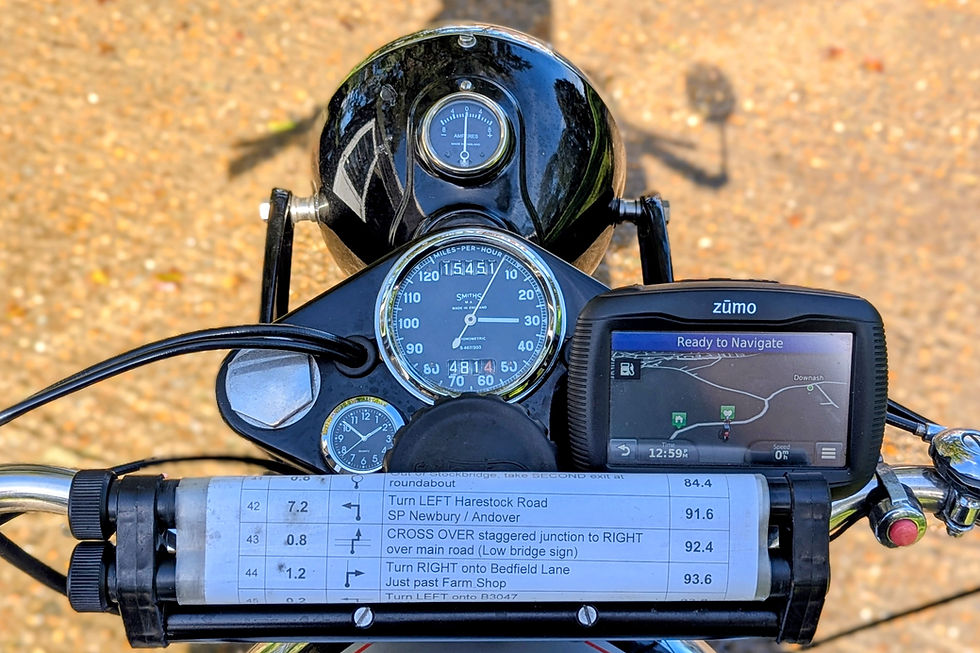
If I am covering larger distances on my own, or looking for somewhere after getting lost (it happens) I find the satnav invaluable. It can also be set to show me the local speed limit. Seeing this in mph is very useful in France where they are so hot on speeding in towns!
Conversion to 12V
I only changed to 12V because it was the easiest way to connect the aforementioned satnav to the bike. This was very simple using the AO Services regulator which I'd had on the bike from day one. I still used the standard E3LM dynamo which, with an LED stop/tail light and a sensible choice of front bulb wattage keeps up just fine.
I tried an LED headlight bulb when they first came onto the market and was very disappointed. It was incredibly bright but there was no beam to see where I was going. I only used it once at night before going back to standard filament bulb. I appreciate they have come a long way since, but I so rarely ride the bike in the dark I've never tried another one.
Tyres
As you might expect, I've worn out a couple of sets of tyres in the last 15,000 miles. I first put the ES2 on the road with the traditional Avon Speedmaster on the front and SM MkII on the back. They lasted well but I didn't like the square profile on the back. I use these tyres on a couple of other bikes but I found that with all the luggage on I wanted to run slightly higher tyre pressures. I never managed to get it to feel 'right' - when the pressures were low, the bike wallowed in the corners. If I put a bit more air in, it felt harsh and the square edge made the cornering feel twitchy.
I replaced these with a set of Avon AM26 Roadriders. I had to open the front mudguard bracket out slightly to give clearance on the wider front tyre, but it was worth the work. With their more modern, rounded profile, these tyres transformed the handling of the bike. I could run the higher pressures without causing the handling issues I found with the old SM Mk2.
There is only one problem with these tyres - they've stopped making them in the UK! They are due to resume manufacture in Europe, but I have read that they won't be available again until late 2027. That has already been pushed back from 2025, to 2026... I'm not holding my breath and I do now need some new tyres for my ES2, so I am going to have to look elsewhere before next summer. I will update this page when I have selected some tyres and tried them.
Toolkit
This could, and probably will, become a page all of its own. My toolkit has evolved over the years and now carries plenty of kit never found in the bike's standard toolkit. One of the great things about the Nortons is that they do have a very large toolbox so there is plenty of space.
In my experience - if you can just about get everything in a toolbox when you pack it in the perfect order, in a warm dry workshop, you don't stand a chance of getting it all back in on the side of the road while it's raining!
As well as everything photographed above, I keep my adjustable spanner in the top of the T-shape battery box, it's easy to get at and doesn't require me to get everything out for a quick job that could be solved in 30 seconds. I use this as much to keep others going as myself, because it is so quick to get at.
What Would You Like to Do Next?
Read more about my 1951 Norton ES2
Follow me on a Long Weekend Away on my ES2
Comments